Even before the incarceration camps closed, many Japanese Americans advocated for ways to leave, particularly for young adults. Through various programs, incarcerees left for the Midwest or East Coast by going to college or securing a job outside of camp. Those with professional degrees had an easier time of finding employment. Many eligible young men volunteered to join the army from behind barbed wire. Most joined the 442nd Regimental Combat Team, a segregated unit which was later celebrated for their sacrifice and bravery in Italy.
There is no exact data of who returned to Berkeley of those who were removed. Out of the 120,313 who were under War Relocation Authority control at some point during the war, 54,127 returned to the West Coast by 1946. Nearly 5,000 voluntarily relocated to Japan after being incarcerated by the United States, and nearly 53,000 relocated to the interior or Hawaii. Many were located elsewhere in the immediate aftermath of the war but eventually returned to the West Coast when jobs and housing became more readily available.
“… we felt truly fortunate. We had a house waiting for us; most of those released from the camps had no shelter. Some families lived in churches and slept on the floor… Three years of living on a sixteen-dollars-per-month salary meant that most of us returned to California in debt and with little or no savings.”
-Fumi Manabe Hayashi, Making Home From War.
In Berkeley as in many other communities, Japanese American churches were community hubs that took on a central role in the post-incarceration period. Most churches had stored their members’ belongings during the war, and now became temporary living accommodations. Due to Alien Land Laws, most Japanese Americans did not own the homes they lived in prior to WWII. Berkeley’s population had swelled with wartime workers from 1942-1945, many of whom had rented emptied homes previously occupied by Japanese Americans.
Some Japanese Americans, particularly returning veterans, found housing in Codornices Village. Restrictive housing was still in place, and most returnees remained in the same neighborhood where they had lived prior to the war.
Families who were able to purchase property before the war, usually by putting it in the name of minor American-born children, had an easier time returning to Berkeley since they had a place to stay. Below is Jeanie Kashima’s story of the home that enabled her family to stay in Berkeley for many generations.

“The Fulton Street home was purchased by my grandfather Buntaro Takaki, who put the property in the name of a nine-year-old U.S. citizen, my father. This was done to evade Alien Land Law restrictions amid significant opposition by the neighbors.
Buntaro was a carpenter and enlarged the house, enabling him to rent to Japanese students who would not have been able to rent in this part of town. In 1942, my family was sent to the Tanforan assembly center, then transferred to the Topaz concentration camp. We were released from Topaz in 1945 and returned to the Fulton Street home. In 1946, my mother gave birth to my sister and lost her husband three months later, leaving her a widow with three children. Fortunately, my Uncle Ernie inherited the property and allowed us to stay. When he passed away in 1996, his estate went through probate but I was able to buy the house. My mother died there peacefully in 2020, at the age of 104.
I continue to own the home which is now used by fourth and fifth generations of the Takaki family. I will keep the home as a testament to my family’s history.”
– Jeanie Kashima. Her mixed media collages honor her family’s history. This collage, showing five generations at the Fulton Street House, was loaned to BHSM for the duration of the exhibit.
Moving to Berkeley
While some Japanese Americans from Berkeley had moved away permanently, the city attracted others to move here for the first time, due to relationships formed in the camp, job opportunities, or for a fresh start.
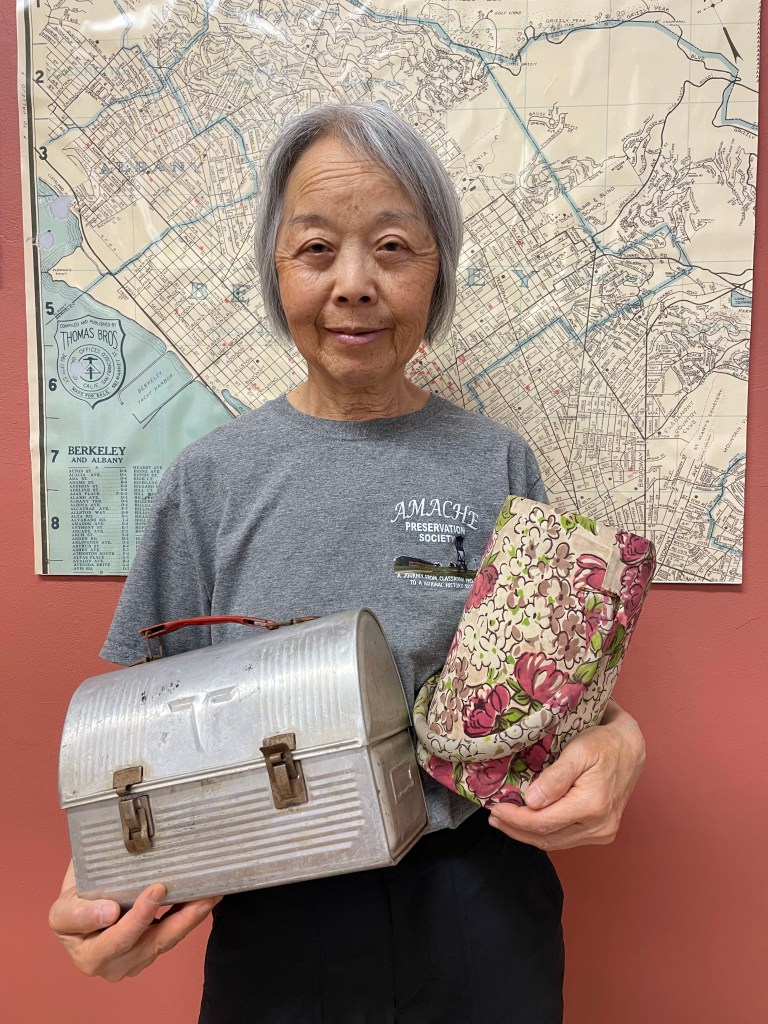
Arlene Makita-Acuña’s family first moved to Berkeley after the war, and she was born at Herrick Hospital.
These objects symbolize her parents’ camp experience at Amache in Colorado, as well as their postwar experience, when they moved to Berkeley.
The knitting basket, on the right, is made from an old Quaker Oats container. Makita-Acuña says that many Japanese American women learned crafts in camp. The lunchpail was used by her father every day at work.
Remembrance
“This is the last Sunday of our lives outside of the barbed wire fences.”
-Reverend Lester E. Suzuki, 1942. From The Sunday Before.
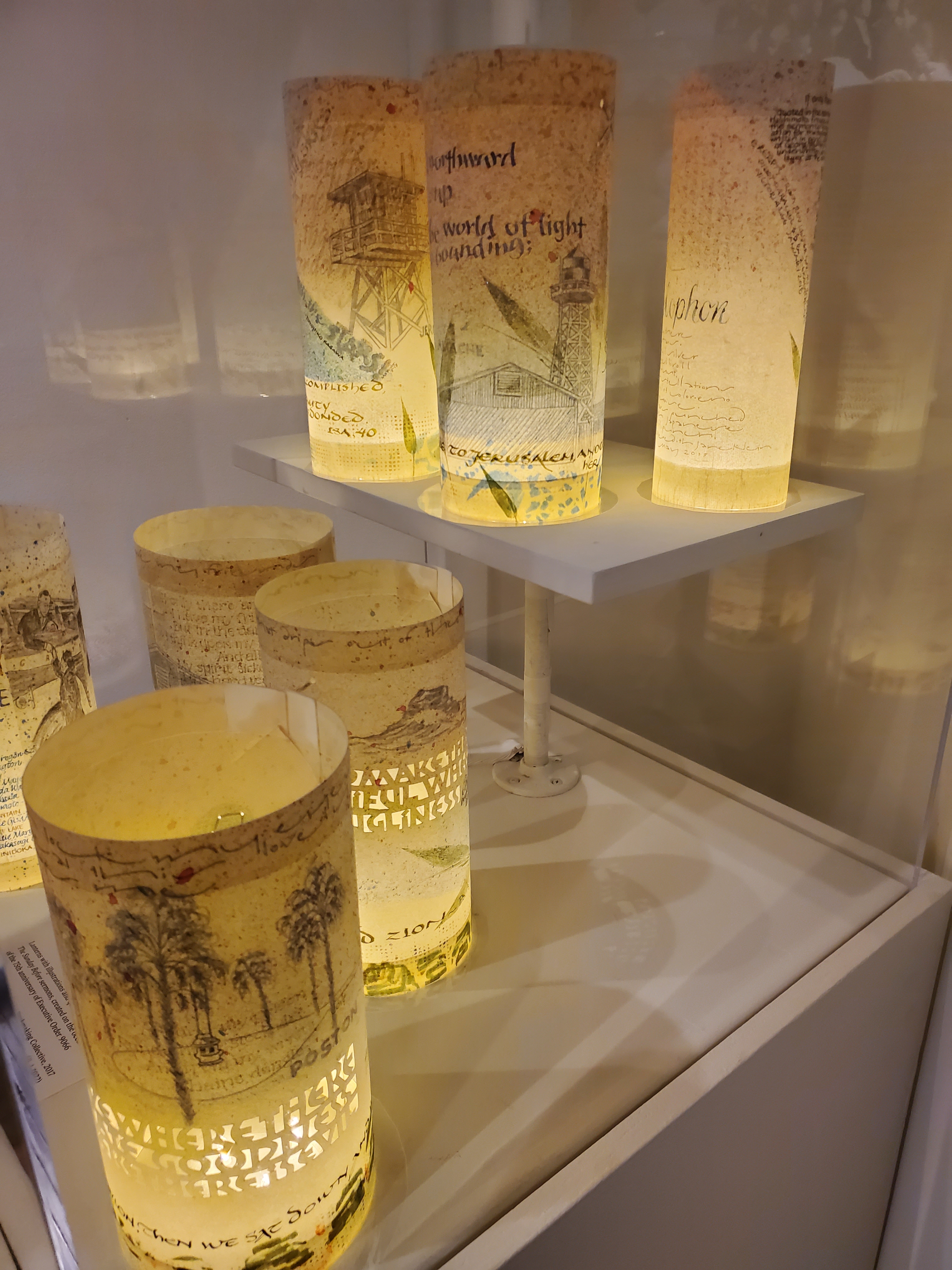
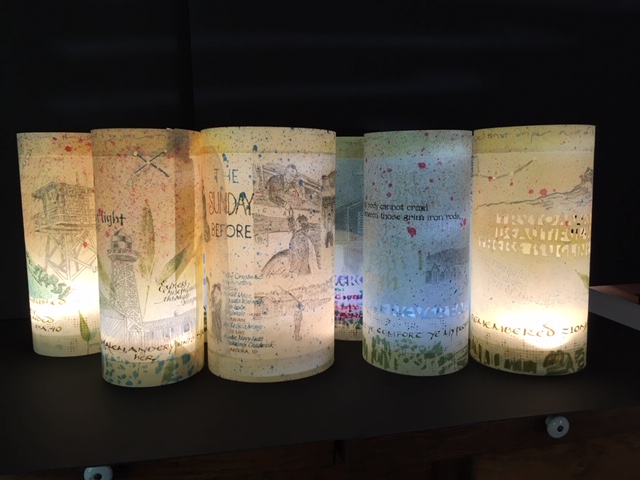
The Sunday Before by Mary Ann Wight
In July 1945, almost a month before the first Berkeley families began to return from years of incarceration in remote and segregated stockades, the American Friends Service Committee of Pasadena published a booklet, The Sunday Before. It contained sermons from new and seasoned pastors of seven 1942 Japanese Christian congregations in Fresno, Wintersburg, Pasadena, and Los Angeles. The sermons conveyed pathos and love in one last message to their flocks as they prepared to leave their emptied homes and churches for an unknown future.
In 2017, seventy-five years after President Roosevelt’s Executive Order 9066 that authorized the forced removal of Japanese Americans from the West Coast to internment camps, a reconceptualized The Sunday Before became a visual signifier to a new generation. The Round Robins, a group of six book artists, have been writing and assembling one-of-a-kind artist books since 1998. The name Round Robins refers to a pattern of passing the book pages from person to person.
“…When all things are taken from us, we shall have yet people who we can love. When we can do nothing, we shall have occasions and opportunities to exercise love…”
-Reverend Kenzon Tajima, 1942. From The Sunday Before.
Because of the subject matter, the pages of The Sunday Before, designed on varied lengths of paper, were painted, stenciled, even perforated, before being waxed and then curled into a nested set of concentric lanterns. Separately illuminated, the lanterns represent six of seven camps where people from California communities were incarcerated, overseen by the Jerome, Arkansas, guard tower and graphite sketches of other distinguishing features: Heart Mountain, Wyoming; the Manzanar, California chapel; the checkered Amache, Colorado water tower; and Poston, Arizona palms.
Through the ability to rent a farm outside of the Oregon exclusion zone and multiple trips to relocate nine family members and their farm equipment, my father’s family was able to avoid incarceration. On the title panel, I pay tribute to my aunts and uncles who had no such option: Gish Amano, Tule Lake, California; Mary Sato Wakasugi, Minidoka, Idaho; and Maye Yasuda Wakasugi Umemoto, Heart Mountain, Wyoming.
–Mary Ann Wight is an artist based in Berkeley, and contributed to this exhibit.

The piece “Scarred”by Ellen Bepp is an altered Civilian Exclusion poster historically used in 1942 to order the removal of Japanese Americans during WWII. The words “I Am An American”are hand cut into the poster which emerges from the artist’s grandmother’s vase that she used for creating her traditional Japanese flower arrangements. The pleading image of cut out text is viscerally disturbing in contrast to the vase which is symbolic of harmony and grace in the art of flower arranging. The poster rises from a mound of sand conjuring up images of the barren desert wastelands of the WWII camps. The table the piece rests on was made by Ellen’s father, Yoneo Bepp.
Courtesy of Ellen Bepp.
 BHSM Online Exhibits