
Establishing a Japanese American community in Berkeley

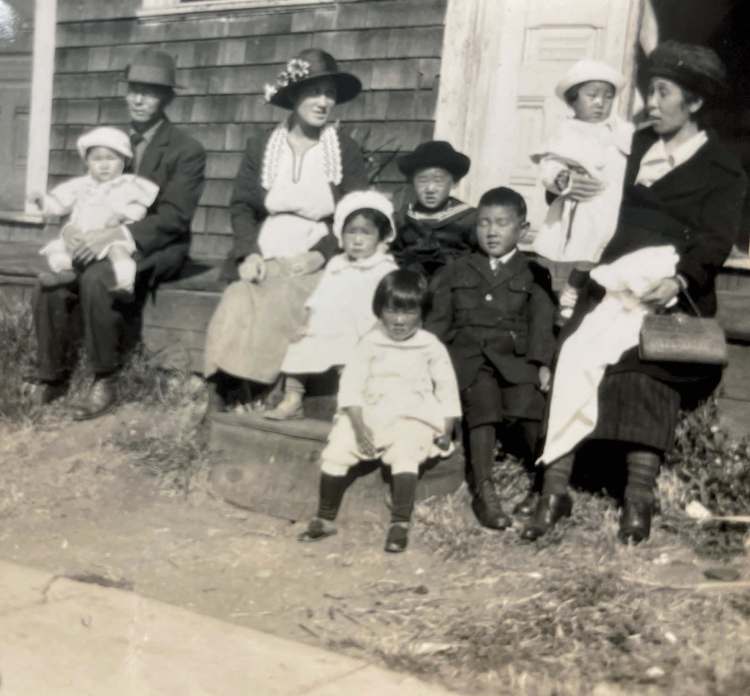
Front from L: Mary, Hayaji and Sam. Courtesy Oda family collection.
Heihachi and Yaye Oda (Hiroshima prefecture) came to the U.S. in 1906, after Heihachi served in the Russo-Japanese War.
By the 1920s, he had established the H. Oda Company, an egg delivery business located at 1744 McGee Avenue. It did not survive WWII.
Heihachi served as the first president of the Berkeley Buddhist Temple from its founding in 1911 until 1935. One grandchild, three great-grandchildren, and two great-great grandchildren still live in Berkeley.
Here Lived: 1744 McGee
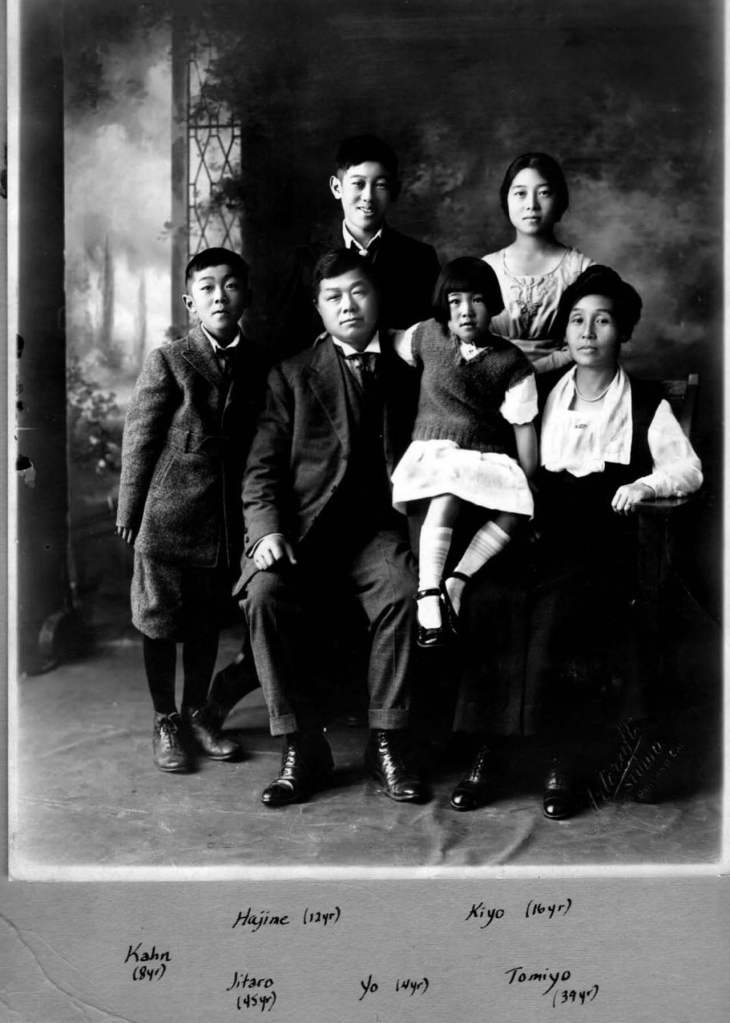
Jitaro Uyeyama, from Oita Prefecture, and Tomiyo Nakagawa, from Sendai City, met in Tokyo at a Christian conference. They married, gave birth to a daughter, Kiyo, in Japan, in 1900, and moved to California. Three children were born in Berkeley: Hajime (1904), Kahn (1908) and Yo (1912) in the house the family rented at 2121 Blake Street.
Jitaro was a successful New York Life insurance agent. He traveled to the Sacramento Delta and down to Fresno from his base in Berkeley and Oakland. That was how they were able to afford to send Hajime and Kahn to the University of California San Francisco Medical School.
Kiyo and Yo were among the first Japanese American women graduates of U.C. Berkeley. Hajime later purchased a home at 2808 Grove Street from which he and the family were forcibly removed in 1942.
Here Lived: 2808 Grove Street
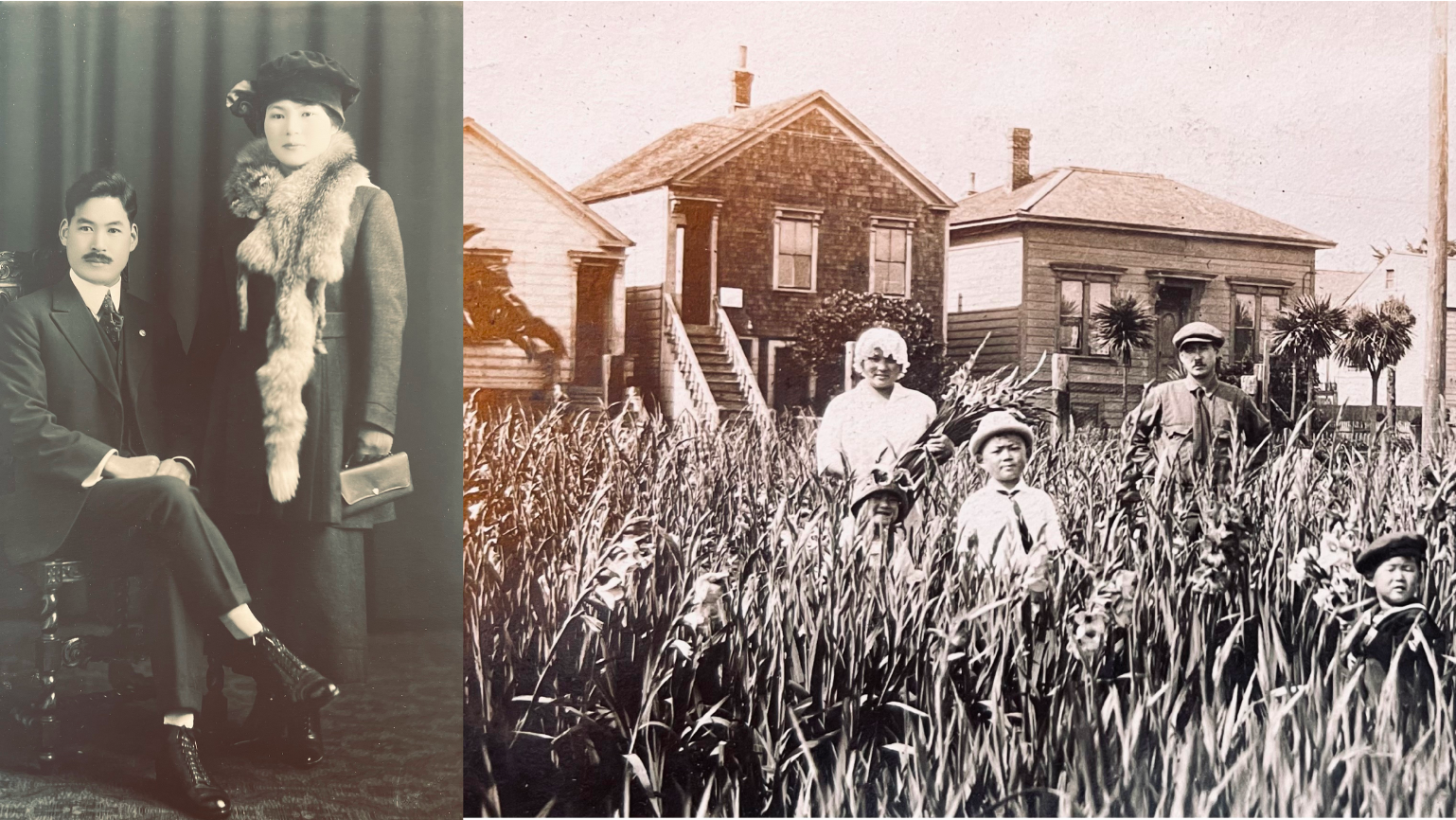
Courtesy of Ukai family collection.
Tokutaro Takayanagi and Hide Ishikawa Takayanagi, immigrants from Shizuoka Prefecture. Tokutaro and Hide ran the Taka Nursery, selling cut flowers from their home business. A chauffer would bring a wealthy patron once a week to buy fresh cuttings, but the family had little money for extras. Fumiko recalls that at Christmas, she and her brother Tadao would wrap up their belongings and “exchange gifts.”
When the 1942 removal came, her father packed a small box in addition to a container each of tools and clothing. When the family got to camp, Fumiko discovered he had used the precious space to carry eucalyptus leaves. “I made him ashamed that he needed that reminder of Berkeley so he wouldn’t get homesick,” she wrote during Redress hearings. “It makes me sad and angry now to think that I directed my anger at my father, instead of the true villain, the U.S. government.“
Here Lived: 1920 Sixth Street
Uyeyama family.

Bottom: c. 1946, in front of 1651 Tyler Street home with grandchildren. From left: Julia Nakamura (Kozen), Jeanne Nakamura (Frost) and Ken Nakamura.
Courtesy of Nakamura family.
Yone and Sotaro Nakamura, immigrants from Fukuoka Prefecture.
Sotaro and Yone arrived in San Francisco on November 3, 1905. They settled in Berkeley in 1910 at 285 Piedmont Avenue. They had three sons: Shigeru, Susumu and George. Shigeru earned a degree in economics from U.C. Berkeley, but graduated during the Depression.
The grandchildren were born in 1941 (Berkeley), 1942 (Tanforan), 1943 (Topaz), 1947 (Berkeley). During the incarceration period, an attorney rented both homes and used the money to pay mortgage payments and taxes on the properties. “Because of him we had houses to come home to. We lived in the homes until the 1950’s,” says Julia Kozen, Shigeru’s daughter.
Here Lived: 1651 Tyler Street (Yone and Sotaro),1426 Parker (son Shigeru and his wife, Natsumi, and four grandchildren.)

Kozo Yatabe and Rui Yatabe, immigrants from Chiba Prefecture
Kozo Yatabe learned to make shoes in Japan. He had shoe repair shops in San Francisco before moving to Berkeley in 1926. The shop was at 835 University Avenue and the family lived in the house behind it. During the incarceration at Topaz, a Mexican family rented the house. The manager of the local bank was a friend and collected the rent.
After Topaz, Kozo reopened the shop but retired a few years later. Rui, his wife, besides raising five children, worked in the homes of Caucasian families. In her later years, living to 103, she was cared for by youngest son Motoki. At the time of the forced removal, Motoki was working as a gardener. He was 25 and the only one left to help his parents prepare for the move. He talked about his dog Pete, who had been his beloved companion since his early teen years. “He only ate rice, not bread, what could I do? I took him to Berkeley Humane.”
Here Lived: 835 University Avenue


Moichi Kubota, (Fukuoka Prefecture) first arrived in the United States with his wife to live and work in Isleton. Their address was documented on the Shima Tract, owned by the “Potato King,” George Shima, also from Fukuoka. Like Shima, Moichi Kubota, his wife, and their four sons, later moved to Berkeley. Kubota wanted to provide his sons with a better education, including Berkeley High School. Tsugio Kubota designed the 1939 Olla Podrida (above). The boys watched Cal games from “tight wad hill.”
Moichi became a gardener. When WWII began, he had just bought a truck for his business, which he was forced to sell before being forcibly removed to Tanforan. He made Berkeley his home, and returned to his gardening business after incarceration. He died here in 1953. His son Tsugio’s daughter, Naomi Kubota Lee, lived in Berkeley and graduated from Cal. Later, both of her sons were born in Berkeley.
Here Lived: 1937 Bonita

Isamu Takahashi (Miyagi Prefecture) and Masu Takahashi (Saitama Prefecture) Isamu Takahashi emigrated from Tokyo to the U.S. at around age 18, arriving in San Francisco in 1900. The 1910 census lists his occupation as tailor and records that he owned his own shop. He married Masu Yasu Tanaka on June 13, 1910. He was a truck driver at the time. By 1930, he was a nursery manager in Berkeley. The family story is that he worked with roses and developed the “San Lorenzo Rose,” only to lose the recognition to the nursery owners. Isamu and Masu raised four daughters, all of whom had married when WWII started. They were incarcerated with three daughters at Tanforan and Topaz.
Here Lived: 2907 Harper Street
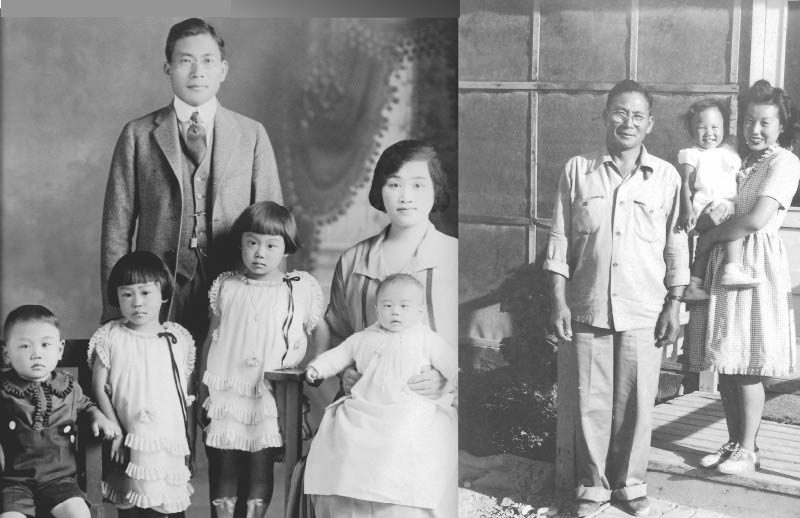
Courtesy of Claudia Katayanagi on behalf of the Katayanagi Family.
Katayanagi family. Here Lived: 1621 Parker Street (Yaeko, Takeshi and Kathryn).

The Tsukamoto family is pictured above in front of the Berkeley house at 2327 Fifth Street. From left, Mitsuru, Tatsujiro and Fujiko Tsukamoto. Leslie Tsukamoto, who shared this photo, said, “I don’t know how they got so interested in cars!”
Here Lived: 2327 Fifth Street

Fukutome Family. Yonojo Fukutome worked in San Francisco but purchased a home on Julia Street in Berkeley through Kiyoshi Togasaki, a U.S.-born citizen who bought property and held the title for Issei who desired to acquire land but were unable to do so legally. When the WWII exclusion orders were issued, Yonojo moved the family to Reedley, in Fresno County, in hopes of escaping the camps, but they ended up imprisoned at Poston, Arizona. Eldest son Ichiro and Lily Kambara Fukutome were sent to Tanforan from Berkeley and then to Topaz, Utah. The extended family reunited at the Julia Street home after the war. When Yonojo became a naturalized citizen, he finally was able to put the house in his name, in 1960.
Here Lived: 1608 Julia Street

Kanichi Yamamoto immigrated from Yamaguchi Prefecture in 1902. He married Ima Onouye and they had six children (back row). Ima died in the 1920 flu pandemic. Kanichi then married Tame Onouye, and the couple had six more children (front row).
They rented the 1608 Oregon Street house and purchased it in 1938 for $1,700. Many of the children were born there. In 1942, the family escaped to the Central Valley “white zone” to try to avoid the camps. They settled temporarily in Sanger but got moved into the Gila River prison camp in Arizona. In 1952, Ted and Barbara (Yamamoto) Ono opened the Gift Basket. They started selling fruit baskets but began to specialize in selling baskets from around the world and Japanese goods. The first store was on Shattuck and Berkeley Way and the business later moved to Solano Ave. Ted closed the shop in 1994.
Here Lived: 1608 Oregon Street.

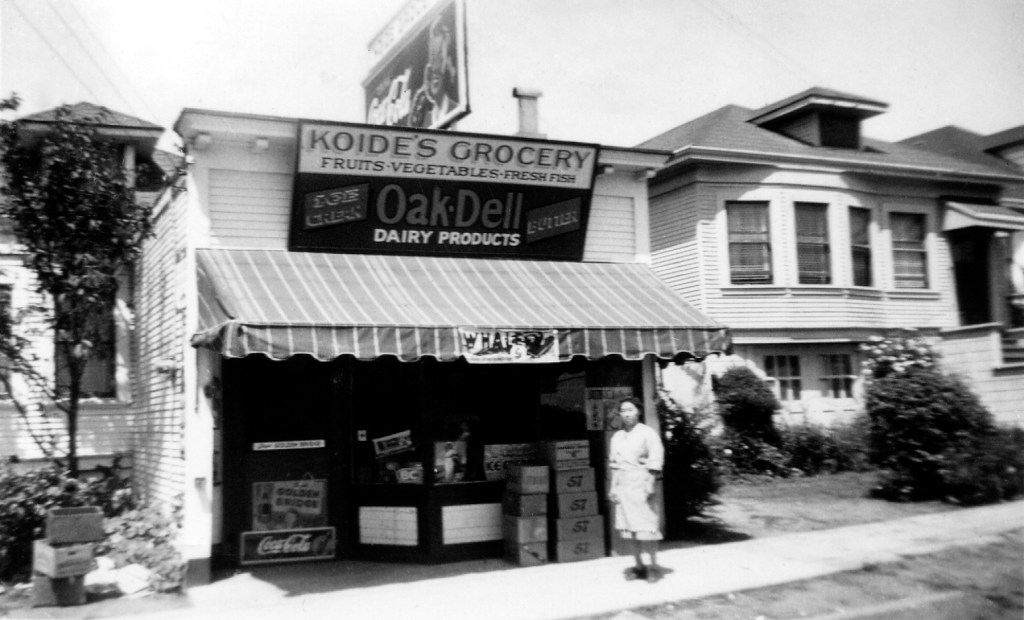
Left: Tsure Koide and daughter Ruth, c. 1939; Right: Koide Grocery, 1715 Ward, pictured in 1950. Courtesy of Ruth Koide Ichinaga.
Koide family. “I grew up in Berkeley on Ward Street. I lived there until our removal to Tanforan and then to Topaz. We came back to the same address after the war.
Our little neighborhood grocery store was attached to our house. When we were not in the store and we heard the cowbell attached to the store door, we came down the stairs from our home to wait on the customers. Our store address was the same as our home address.”
-Ruth Koide Ichinaga
Here Lived: 1715 Ward Street


Makita family. Large portrait shows Tomoyuki Makita, age 4, with his family in Tottori Prefecture in circa 1908. To the right, Tomoyuki “Tom” Makita and Grace Makita with their corn crop in their backyard, 1595 Holly Street, 1976. The Makita family moved to Berkeley after being incarcerated at Amache.
Courtesy of Arlene Makita-Acuña


Sagimori family.
Samejiro Sagimori was born in 1892 and immigrated around 1916 from Osaka. He worked as a gardener and later in a laundry. He was a Christian and belonged to a Japanese Christian church in Berkeley which was merged into what is now Berkeley Methodist United. One of his sons, Thomas Sagimori, attended Berkeley High School and Cal, where he majored in Forestry. Tom enlisted in the Army in 1941, was assigned to the 442nd RCT and was killed in action in Italy in 1945 while the family was imprisoned at Topaz.
Samejiro and Suye had five children. Suye was born in 1894 in Osaka. She was an excellent cook and was known for her delicious pastries and for making pies when friends came to visit. Their granddaughter, Wendy Ng, retired in 2024 after a 36-year career as a professor and university administrator at Cal State University East Bay and San José State University. Her mother is Haruye Sagimori Ng (not pictured).
Here Lived: 2022 Dwight Way
On the next page: Five generations of Japanese American families in Berkeley. Click “2” to go to the next page.
 BHSM Online Exhibits