Japanese immigrants quickly established churches and other places of worship in the Bay Area. These churches became important community spaces, sponsored youth sports teams, and provided support throughout and after incarceration.
- Berkeley Buddhist Temple
- Berkeley Free Methodist Church
- Berkeley Methodist United Church
- Christian Layman Church
- Higashi Honganji
Berkeley Buddhist Temple

On May 10, 1911, seventy-three young people gathered for the first time in the International Organization of Odd Fellows Lodge in Berkeley. This event marked the beginning of the Berkeley Buddhist Temple. At first meeting in people’s homes, the Berkeley group found accommodations in the Chitose Hotel at Channing Way and Ellsworth Street. Heihachi Oda was elected the first president of the group, and he would go on to serve as president for the next 24 years, until 1935.
The building at 2121 Channing Way was purchased and was dedicated as the new Hondo (worship room) of the Berkeley Buddhist Temple on February 13, 1921. The newly formed Buddhist temples in North America found themselves in the middle of growing anti-Japanese hostility. The Berkeley Buddhist Temple under the leadership of Rev. Daisho Tana offered a familiar, spiritual refuge from the hostility and exclusion by accepting the immigrants and offsetting their feelings of isolation and alienation.
In 1945, following the war and upon the return of Japanese Americans to Berkeley, Berkeley Buddhist Temple members, under the leadership of Rev. Kanmo Imamura, operated the temple for more than a year as a hostel, community center, and place of religious refuge. In October 1949, Bishop Enryo Shigefuji of the Buddhist Churches of America began conducting study classes at the home of Mrs. Shinobu Matsuura in Berkeley. The study classes soon moved over to the temple and continued there for more than a decade. They were to become a seed for contemporary Buddhist thought in the 50s.

Buddhist Study Center group reunion photo taken 1989. Seated L to R: Sadako Kashiwagi, Marrie Yamashita, Jane Imamura, Alex Wayman, Rae Imamura, Hitoshi Tsufura; Standing: Dick Fujioka, Hiroshi Kashiwagi, Cal Steimetz, Ken Tanaka, Greg Gibbs, Mrs. Jackson, Robert Jackson, Rev. Seishin Yamashita, Lily Fujioka. Source: Berkeley Buddhist Temple Archives.
Classes would later be taught by such renowned scholars as Professor Ryosetsu Fujiwara, Alan Watts, Lama Tokan Tada, and Professor Richard Gard. In addition to young Nisei students, people such as Gary Snyder, Alex Wayman, Watts, and Jack Kerouac were attracted by the challenging, thought-provoking discussions.
Berkeley Free Methodist Church
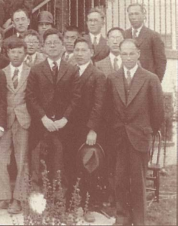
The Berkeley Free Methodist Church was founded in 1923 by Masamoto Nishimura. Church meetings were first held in private homes and then at the church’s first permanent location on Dwight Way east of Shattuck. The church later moved to Derby St., across from Longfellow School, where it existed through most of the 1980s.
At its founding, because the majority of its members were Japanese-speaking Issei, the main religious services were conducted in Japanese. Hymns were sung in both English and Japanese. In the post–World War II years, separate English and Japanese services were held.
Because Masamoto spoke fluent English as well as Japanese, he also was able to help many of the Japanese-speaking church members take care of business in their daily lives—for example, helping them receive medical care in English. In addition to being religious, the ministry offered a means of providing social services for seniors.
Speaking of the post-war years, Arlene Makita-Acuña, a church member, recounted, “Our church was the more conservative of the two in our community. We were not allowed to hold bazaars or festivals of any kind, especially because that entailed money handling. We were strictly an almost literal scripture–based worship community.”
Berkeley Methodist United Church


In 1929, the Berkeley Japanese Methodist Church (founded 1892) and the Berkeley Japanese Christian Church of the Disciples of Christ (founded 1903) were united into the Japanese Berkeley United Christian Church. Construction of a chapel at the Carleton and McGee site began in 1931.
During the internment of Japanese-Americans during World War II under Executive Order 9066, the church, once a house of worship, was boarded up as a storage warehouse for members’ furniture and household goods. At the end of the war, the church served as a hostel for church families returning to Berkeley.
In 1950, the church was renamed the Berkeley Methodist United Church (BMUC). In 1952, Rev. Lester E. Suzuki was appointed to the church as the first full-time bilingual Nisei minister. In 1977, Rev. Grant Hagiya became the first Sansei minister to serve BMUC. In 1983, Michael Yoshii, a seminarian at Pacific School of Religion, began the groundwork for a ministry to young adults and young families. In 1997, Rev. Naomi Southard began her inspirational ministry at BMUC.
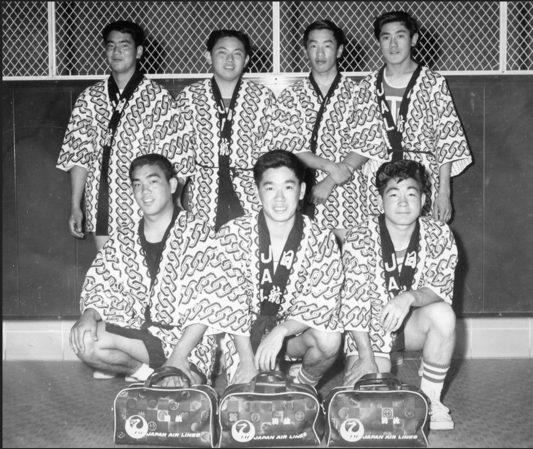
front row: David Fujita – Ed Nakamura – Robert Otani; top row: Ken Fujita – Ron Yoshimura – Gene Nakamura (future Berkeley High School women’s basketball coach) – David Tom
Like other Japanese American churches after WWII, BMUC sponsored a number of youth sports teams. Today BMU remains active at its Carleton St. location.
Courtesy of Berkeley Methodist United Church.
Christian Layman Church
The Christian Layman Church was established in 1922. In the first few years, the congregation met in their own homes. Rather than hiring a church leader, they relied on their own members as lay leaders (hence the name “Layman”). Sharing personal testimonies was an important piece of any service.
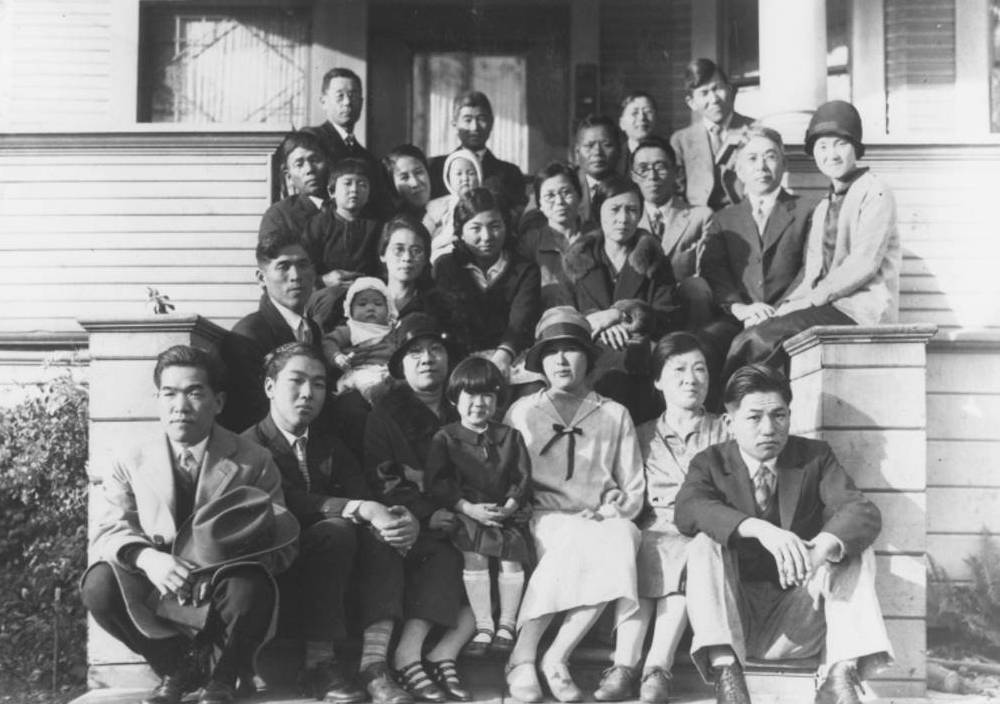
Group photo of Christian Layman Church, 1927, Berkeley. Father Takeji Manabe is in second row from top carrying young Emi Manabe. Chitose Manabe (mother) is holding Fumi Manabe (in light colored baby bunting). Sachi Takahashi is the girl in the middle front (dark dress). Source: Christian Layman Church
Two prominent founding families were the Matsuokas and the Sanos. Both hosted church meetings in their homes, which were a few blocks apart. Both Hisashi Sano and Ryosaku Matsuoka had become Christians while still living in Japan, during the time in which the lay church movement became popular. Takeji Manabe and his family also became integral members of the church.
In 1928, the congregation bought a two-story home at 1707 Ward Street, next to the Matsuoka home. Due to alien land laws, the property could not be purchased by the Issei immigrant church leaders. Instead, the building was purchased in the names of four Nissei, ranging from 12 to 21 years old.
When Japanese Americans were incarcerated during WWII, many families stored their belongings in the church building at 1707 Ward. Services continued to be held at Tanforan and at Topaz, where Protestant services were held by a rotation of ministers. In Topaz, many Christian Layman Church members were exposed for the first time to services held in English; after the war, the church began to hold both English and Japanese services.
Church members who returned to Berkeley found that the War Relocation Authority had rented the church building to tenants during their absence. While they waited to return to their building, the congregation again held services in private homes, including the Matsuoka home. Both the church building itself and the homes of congregants served as temporary housing for the many displaced Japanese Americans returning from incarceration.
The Christian Layman Church expanded in the postwar years and was able to construct a new chapel adjacent to the 1707 Ward building in 1958. The church eventually outgrew its Berkeley buildings in the early 1990s and moved to Oakland, where the congregation is still active today.
Higashi Honganji
Berkeley Higashi Honganji Buddhist Temple was established in 1926 by about sixty Japanese immigrants. This group had broken off from the Berkeley Buddhist Temple as a result of a dispute concerning the Nipponjinkai (Japanese Association) and the Kyoyu-kai (friends cooperation group). The first meetings were in a building on Haste Street, and Reverend Chijyo Suyemori was the first minister. The temple quickly established a fujinkai (women’s association) and youth group.
The temple at 1524 Oregon St. in South Berkeley was built and dedicated in 1938, following donation of the temple property by the Fujii family, who operated a nursery next door. As the temple’s membership grew, additional buildings were added, including a minister’s residence which was completed in 1940. The temple was updated with a new facade in 1959, and the Otani social hall was added in the 1960s.
Like other Japanese American religious institutions, the temple was closed from 1942 to 1945 while its members were incarcerated. Reverend Nobuo Matsumoto was the minister of the temple in 1942 and brought the statue of the Amida Buddha, the main symbol of the temple, to the camps with him. The statue returned safely to the church after the war. When members returned from incarceration, many slept at the temple while searching for more permanent homes.
Higashi Honganji is known for its beautiful Japanese garden. The Japanese aesthetic was established in 1976 in honor of the temple’s 50th anniversary. Dennis Makishima took care of the garden for several years and designed its current form.
The Higashi Honganji also sponsors the popular youth basketball team Ohtani, which has existed since at least the 1930s.

 BHSM Online Exhibits