Japanese Americans in Berkeley have created numerous civic and cultural organizations in the East Bay. These groups created a sense of community and belonging even while their members faced rampant racism and discrimination. Many groups worked directly to improve the lives of Asian Americans in the Bay Area.
Japanese Association
The Japanese Association was one of the earliest organizations created by Japanese Americans in the Bay Area. Established in San Francisco in 1900, an affiliate organization was established in Berkeley in 1905 as the population of Japanese families grew. Similar organizations were established by Japanese immigrants nationwide. Japanese Associations created networks of support amidst anti-Asian rhetoric. Berkeley newspapers and organizations, including the Berkeley Parlor of the Native Sons of the Golden West, campaigned against Asian immigration.
George Shima, the National President of the Japanese Association of America from 1908 to 1926, moved to Berkeley in 1909 due to its proximity to the national headquarters in San Francisco. His purchase of a large home at College and Parker created an uproar among white neighbors. Shima advocated against Alien Land Laws that prevented Japanese American ownership and against restrictive immigration laws on the state and federal levels.
The Berkeley Japanese Association acquired a building on Haste Street which became its headquarters. The Association also hosted a Japanese Language School, Judo, and Kendo classes for children. Members were mostly Issei. After the war, the Japanese Association became less central and the Japanese American Citizens League (JACL) grew in popularity.
Japanese American Citizens League (JACL)
The Berkeley Chapter of the JACL was organized in early 1942 with Kimio Obata (son of U.C. art professor Chiura Obata) as president. WWII and the exile of Japanese Americans suspended activities.

After the war, an East Bay Chapter was formed, but it was split in 1953 into Oakland, Berkeley, and Contra Costa chapters. George Yasukochi was Berkeley’s first post-WWII president. The Oakland chapter later merged with the Berkeley Chapter.
Berkeley was fortunate to have active members such as Tad Hirota, Masuji Fujii, Frank and Toshiko Yamasaki, Albert and Ruth Kosakura, George and Bess Yasukochi, Mas Yonemura, Paul and Kay Yamamoto, Bill Fujita, and Terry Yamashita. They developed a robust community program that supported Issei citizenship classes, scholarships, civic talks, picnics, talent shows (one of which included actor Pat Morita), and sports team sponsorship.
The Berkeley Chapter was the beneficiary of the Berkeley Issei Association, which owned a modest downtown site used as the JACL meeting place. The property was sold for $40,000 in 1966, and the Issei fund, supplemented with donations, provides income for chapter activities, scholarships, and subsidies for youth to attend JACL conventions.
In 1957, Ko Ijichi, chapter vice president, achieved a historic high of 487 members. With so many Nikkei organizations these days and the integration of the community, maintaining a high enrollment is challenging. The chapter now works with the Cal Nikkei Student Union and supports their activities and an annual trip to participate in the Manzanar Pilgrimage. The future lies in this generation’s able hands.
East Bay Japanese for Action (EBJA)

East Bay Japanese for Action was founded in 1971 by third-generation (Sansei) Japanese Americans to support the needs of Japanese-speaking first-generation Issei in Berkeley. Emerging from the student activism at UC Berkeley in the 1960s and growing out of the university’s newly formed Asian American Studies Program, EBJA was one of the pioneering Bay Area groups that launched community-based services for the largely underserved elderly Asian American population.
The multigenerational focus of the organization reflected the Sansei generation’s deep sense of respect and gratitude for the elder immigrant-generation of Japanese Americans.
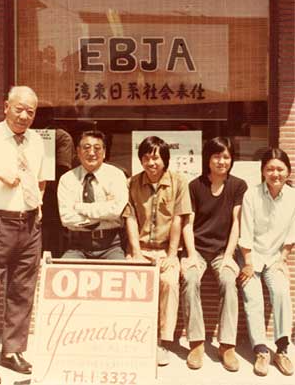
EBJA’s first office was a storefront at 2439 Grove St. In 1986, EBJA merged with East Bay Issei Housing and changed its name to Japanese American Services of the East Bay (JASEB). JASEB established senior-care and nutritional lunch programs, and organized multicultural craft and cultural activities, group field trips, and health screening events as well as bilingual case management.
More than fifty years later, the organization, renamed J-Sei and now located in Emeryville, continues work in the same spirit of intergenerational care for elders, providing a network of care providers, lunch delivery services, and cultural and educational classes for the Nisei and Sansei generations.
Youth Organizations & Sports
There were a variety of Japanese American youth sports teams in Berkeley throughout the 20th century, most sponsored by churches and temples as a result of the racism that left many children of color out of formal sports leagues. Churches and temples hosted youth basketball teams, including the Ohtani Youth Basketball team hosted by Higashi Honganji, which still exists today. These teams competed against each other and against teams across the state.
The Lumpe Lions was a prominent football team which played at halftime in the 1935 Rose Bowl.

In 1957, Minoru (Min) Sano, who had been a star quarterback first on the Lumpe Lions and then for the University of Denver while incarcerated, established the Berkeley Bears youth baseball team. The team played by the motto, “It’s The Way You Play The Game That Counts,” and Min Sano was respectfully known as Papa Bear. Multiple generations learned sportsmanship, teamwork, community camaraderie, and baseball skills.

Top Row: Assistant Coach Mr. Roger Yamashita, Bruce Tsutsui, Dale Sera, Assistant Coach Mr. Art Yamagata, Stan Fuchiwaki, Gary Tominaga, Assistant Coach Mr. Lawrence Yano, Art Yamashita, Glenn Matsunaga, Head Coach Mr. Bob Tsutsui, Ralph Teraura, Head Coach Mr. Bob Murakami.
After the war, Japanese Americans joined neighborhood leagues. Little League teams were segregated by neighborhood. The McNary Chapel team of West Berkeley was diverse and coached by Japanese American Mr. Bob Tsutsui. Other teams included Berkeley Cycle & Toy (1966 League Champions), Cutter Laboratories, Elks’ Club, Mason-McDuffie, O.C. Jones and Thousand Oaks Hardware.
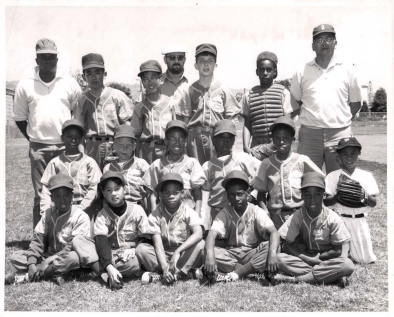
Head Coaches Mr. Martin Manuel and Mr. Bob Tsutsui, Mr. Gene Chenier (Head Coach of Berkeley Cycle & Toy); Assistant Coach Mr. Kavanaugh. Players included Bruce Braxton, George Gifford, Gary Manuel, Greg Schmidt, Danny Sylvester, Gary Tominaga, Bruce Tsutsui, Eric Yamagata, and Kenny Kavanaugh.
Berkeley Boy Scout Troop/Post 26 was founded by Jordan F. Hiratzka in 1950. The troop was sponsored by the Berkeley Methodist United Church, but was an interfaith organization. The Troop 26 famed Drum/Bugle Corps performed at the Cal Football Parade, St. Patrick’s Day Parade and many other venues.

1956 Troop/Post 26 Drum and Bugle Corps.Front row, L to R: Ron Tsukamoto – Gene Hashiguchi – George Furuichi – Gary Tsukamoto – David Fujita – Habo (Howard) Yamamoto – Kenneth Nakamura Middle row, L to R: Kingman Siu – Walter Huey – Gerald Sakamoto – Phil Nakamura – Morris Kosakura – Herb Uyeno – Don Sakamoto – Peewee (Ryu) Inoue – Victor Ichioka – Kenny Yamauchi Top row, L to R: Assistant Scoutmaster Mr. Iwao Masuda – Norman Haraguchi – Robert Abe – Eugene Makishima – Eloy Maoki – Tak Nakano – Dr. Eugene Tsujimoto – Kenny Akiyama – Scoutmaster Mr. Jordan Hiratzka Inset, R to L: David Tom – Norman Haraguchi – Morris Kosakura 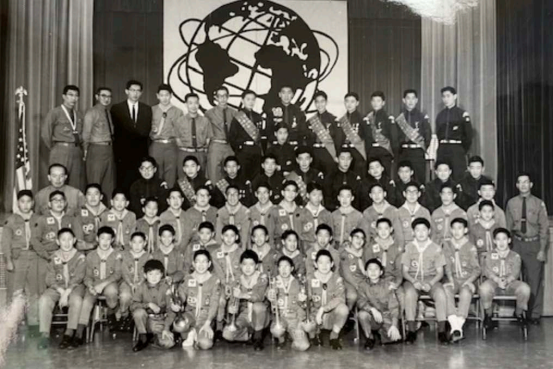
1965 Troop/Post 26. Front row, L to R: Hiro Sugimura – Bruce Morita – Wayne Morimoto – Lindsay Hiratzka – Steve Shimada – Fumio Morishita 2nd row, L to R: Steve Yatabe – Mike Oyama – David Harano – Ken Murakami – Stan Sugimoto – Chris Asami – Gary Tominaga – Eric Yamagata – Lawrence Yano – Keith Ono – Ken Yamashita – Steve Okasaki – David Katayama – Gary Nishita 3rd row, L to R: Bruce Fuchiwaki – Donald Buggs Harano – Gary Sasaki – Dr. Steve Okawa – Lowell Toyofuku – Neil Toda – Albert Sun – Steve Hayashi – TBD – Clyde Takahashi – Richard Teraura – Dean Muranishi – Ted Katayama – Chris Oyama – Dennis Otani – Bob Nakamura – Gerald Kaz Yanaba – Assistant Scoutmaster Mr. Norman Tanabe 4th row, L to R: Assistant Scoutmaster Mr. Roy Kurahara – Dr. Eddy Hayashida – Wayne Kurahara – Dennis Imazumi – Gary Kono – Edwin Sano – Ron Uchiumi – Gerald Shimada – Eugene Endo – Ron Tanizawa – Glenn Shimada Top row, L to R: Scoutmaster Mr. Jordan Hiratzka – Assistant Scoutmaster Mr. Arthur Tad Hayashi – Assistant Scoutmaster Mr. Tak Nakano – Assistant Scoutmaster Mr. Brian Shinoda – Assistant Scoutmaster Mr. Iwao Masuda – Assistant Scoutmaster Mr. George Furuichi – Michael Shimada – Dr. Philip Omi – Todd Fujinaga – Doug Kagawa – Bob Fujii – Frank Tanabe – Aaron Muranishi – Jay Uchiumi
Hiratzka served as Scoutmaster for almost four decades. Alongside him were many assistant scoutmasters and committee members. Parents and other community members were involved in meetings and other events.
Katsudou: No Yellowface


A popular event for the post-war Japanese American community in Berkeley was the screening of Japanese films, put on by churches and organizations as fundraisers. Gary Tominaga remembers:
“During my youth in Berkeley of the Sixties, I have many fond memories of going to see Japanese movies known as katsudou – literally, “moving pictures” – at Garfield Junior High (now King Middle School) and Florence Schwimley Little Theater at Berkeley High School.
Yes, I subsequently found out from my friends in Nihon (the actual name for Japan) that this is an antiquated Meiji Era term for eiga, the modern term for movies. Our immigrant grandparents, many of whom were born in the late 1800s, used such antiquated terms.
These old-time movies provided rare positive role models on the silver screen of actors who looked like me. No Yellowface here. The screenings were warm community events. We’d see friends from other churches and organizations and the tickets were sold to benefit them, priced so that whole families could afford to attend. The Issei, Kibei (born in the U.S. and educated in Japan) and Nisei were bilingual – most Sansei at the time were not. For us, there were subtitles. “
 BHSM Online Exhibits